Custom ERP vs Off-the-Shelf Software: A Decision Framework for Operations Leaders
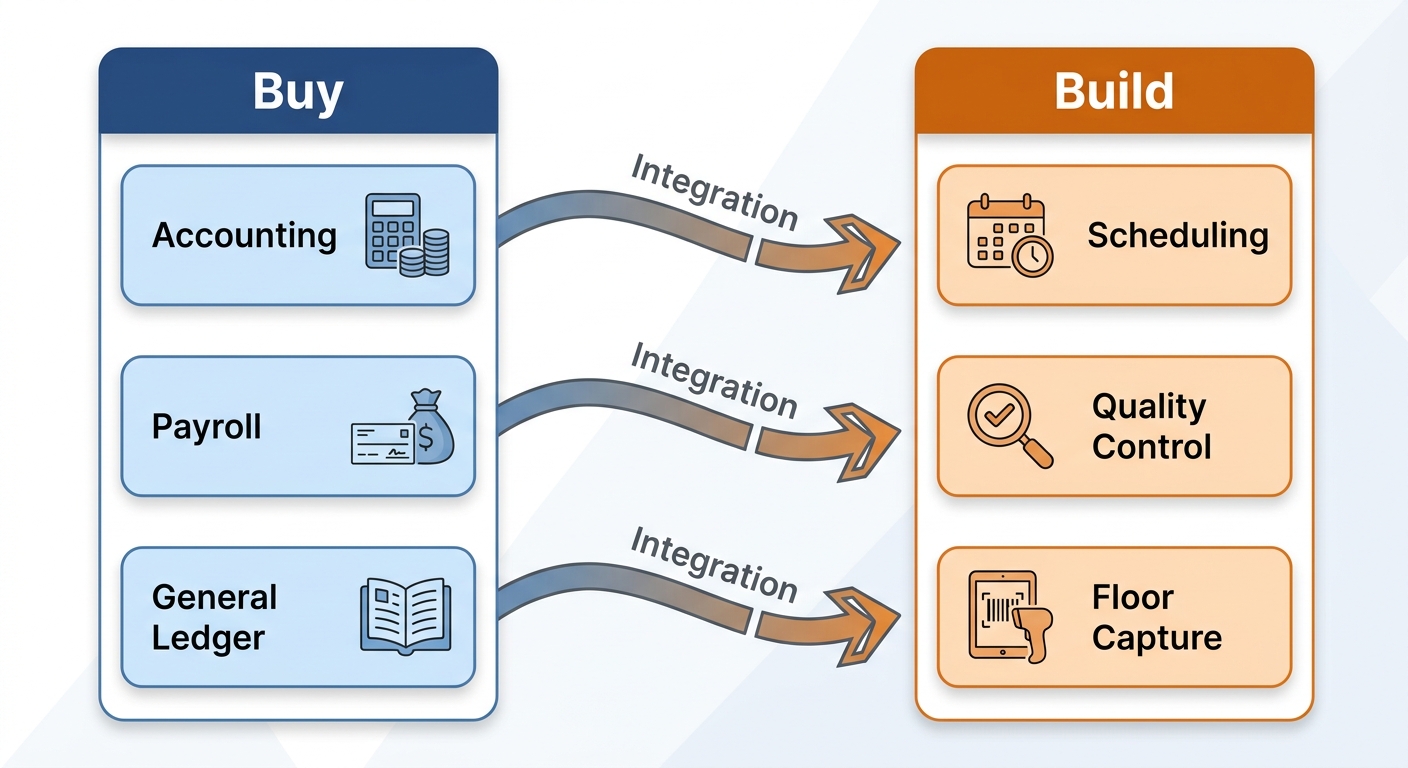
The honest answer for most mid-sized manufacturers is neither extreme. Off-the-shelf ERP works well for processes that already match industry norms. Custom software earns its keep where your operation is genuinely different. The practical route is a split: buy accounting, payroll and the general ledger, then build the production scheduling, quality control and shop-floor capture that standard platforms handle badly.
Key takeaways
- Keep the back office standard. Accounting, payroll and the general ledger are solved problems and belong on licensed software.
- Build custom where you compete. Production scheduling, quality control and floor data capture are where generic platforms force the worst compromises.
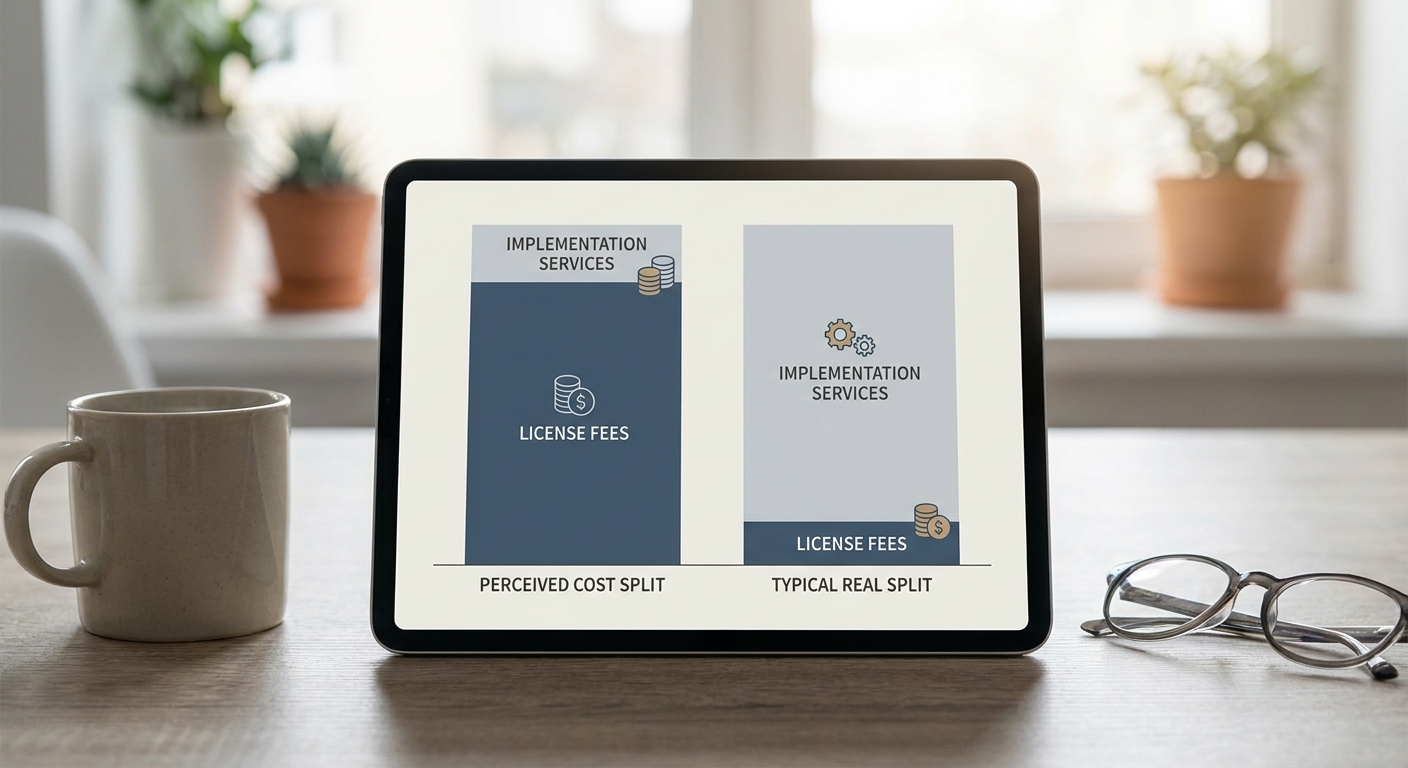
- The license is not the price. Implementation, migration, integration and training usually account for the larger share of first-year spend.
- Per-seat pricing shapes behavior. If every line operator needs a paid login, people stay on paper and the investment underdelivers.
- Small scopes de-risk the decision. A single targeted module proves the approach long before a full rollout commits the business.
The ERP wall
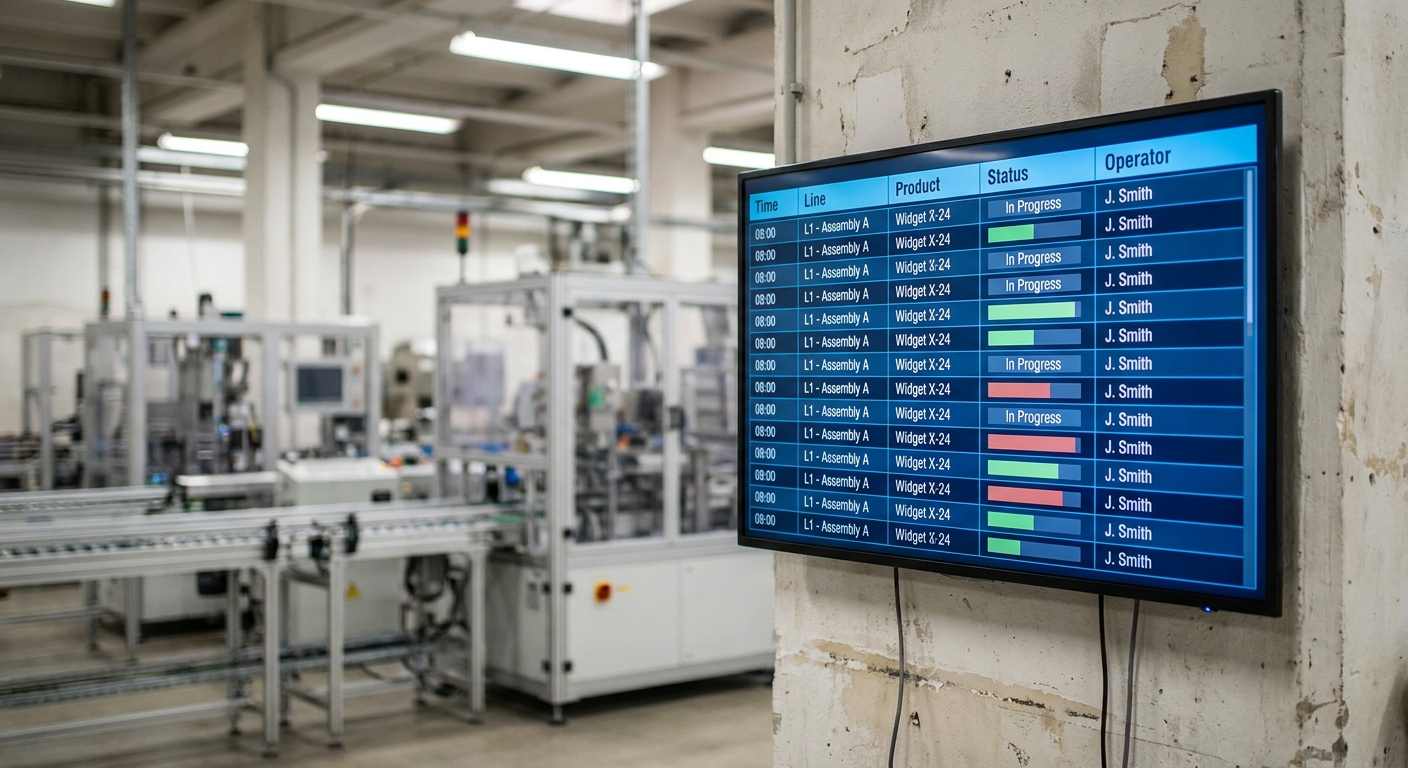
The spreadsheet still works, but only because one person knows how it works. Production schedules live in a workbook. Quality records sit on paper in a folder near the line. The accounting system sees none of it, so finance spends the first week of every month reconstructing what actually happened on the floor.
The warehouse confirms shipments over WhatsApp or LINE. Nobody can say with confidence how much work in progress is sitting on the floor right now without walking out and counting it.
At some point the workarounds cost more time than they save, and somebody says the word ERP. The first quote arrives: a six-figure number attached to a timeline measured in quarters, not weeks. Then someone else says, we could just build this ourselves. Now you have two options and no honest way to compare them.
What each option actually is
Off-the-shelf ERP means a licensed platform with pre-built workflows. SAP, NetSuite, Dynamics 365 and Odoo all fit the description. You pay for the software, then pay an implementation partner to configure it around your business and move your data into it.
Custom software is built to your process. The important point, and the one most articles skip, is that custom does not have to mean a multi-year monolith. It increasingly means a targeted web application that does one job properly: a scheduling board, a digital inspection form, an operator dashboard. The build is measured in weeks, not years, because the scope is a workflow rather than a company.
Most of the confusion in this decision comes from comparing a full ERP platform against a full custom ERP. Almost nobody should build the second one.
The comparison side by side
The track record for large software rollouts is not encouraging. ERP implementations have a long-standing reputation for running over budget, slipping past their deadlines or landing short of the objectives that justified them in the first place.
Timelines run long too. Mid-market off-the-shelf deployments are measured in months rather than weeks. A scoped custom module operates on a different clock entirely, because it is solving a smaller problem.
| Dimension | Off-the-shelf ERP | Targeted custom module |
|---|---|---|
| Upfront cost | License plus implementation and consulting fees | Development cost for a defined scope |
| Time to first useful output | 6 to 12 months for mid-market rollouts | 8 to 12 weeks on AWcode's typical schedule |
| Workflow fit | You adapt to the software's assumptions | The software is written around your process |
| Who maintains it | Vendor maintains the core; you maintain any modifications | You own the code and the upkeep |
| Upgrade path | Vendor release cycle, on the vendor's timing | You change it when there is a reason to |
| Cost over five years | Recurring license fees, often per user | Hosting plus whatever changes you commission |
| Risk profile | Large organizational change, all at once | Narrow blast radius if the first module misses |
| Exit options | Export your data; the platform stays with the vendor | You hold the source code, if the contract says so |
The costs off-the-shelf quotes leave out
The license price is the visible part of the invoice and rarely the biggest part. Discovery, configuration, data migration, integration with the systems you are keeping, training and the change management that follows all sit on top of it. Ask for the implementation quote, not the software quote, and the number usually changes shape.
Then there is the customization trap. Standard platforms enforce standard workflows, which is exactly what you want for accounts payable and exactly what you do not want for a production process that is unlike anyone else's. Modify the platform's core behavior and you create version-lock: the vendor ships an update, your modifications break, and you pay a consultant to repair them. That bill repeats every upgrade cycle for as long as you own the system.
Per-seat licensing creates a quieter problem. The people whose data you most need are line operators, inspectors and warehouse staff, and they are also the people a per-user price makes expensive to include. Companies respond predictably. They share logins, or they leave the floor on paper and key the results in later. Either way the system you bought for real-time visibility stops giving you real-time visibility.
Where custom builds go wrong
Custom software is not a free pass, and anyone selling it as one is not worth listening to.
You own the code, which means you own the bugs, the security patches, the hosting and the statutory updates. When tax rules or e-invoicing requirements change, an off-the-shelf vendor ships the update to everyone. With custom software, you call a developer and pay for it. That is a good reason to keep anything statutory on a commercial platform.
Rebuilding commodity functions is waste. No customer has ever chosen a supplier because of its general ledger. Standard retail and e-commerce, straightforward wholesale distribution and commoditized professional services generally run well on off-the-shelf platforms, and if your processes genuinely match industry norms, buying is cheaper and safer. Say so out loud before you spend anything.
Scope creep is the normal failure mode of custom projects, not an occasional one. A scheduling tool that was meant to solve one bottleneck acquires a reporting suite, then a mobile app, then a feature someone requested in a meeting and never used.
Custom work can also swap vendor lock-in for agency dependency. The fix is contractual, not technical. Insist on intellectual property transfer, written documentation and test coverage, so you could hand the codebase to a different developer next month without drama.
The practical middle
The split that works for most operations is two-speed. Standard software for standard work, custom tooling where the floor is.
Accounting, payroll and the general ledger stay on Xero, QuickBooks or SAP Business One. Those processes are the same in every business of your size, and the vendors maintain them for you. The custom work goes where the business actually differentiates itself: production scheduling with line-conflict detection, digital quality control forms with defect logging, operator dashboards built for a noisy workstation rather than a desk.
Integration is the hinge that holds the two halves together. Custom modules read from and write to the accounting system instead of replacing it, so finance keeps one source of truth and the floor gets software that matches how it works.
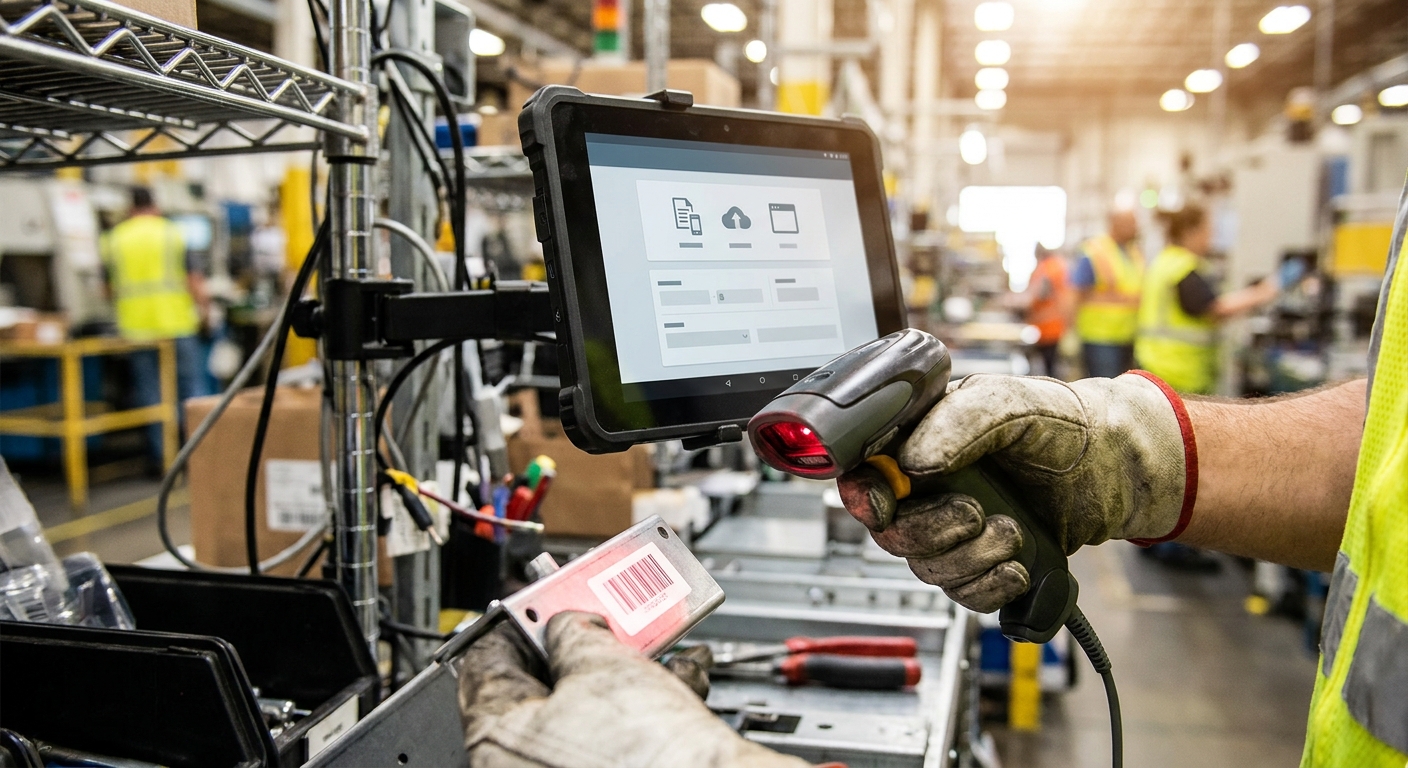
Floor-level reality is where generic platforms struggle most. Staff may be working in English, Thai and Burmese on the same shift. The interface has to survive gloves and glare. Barcode and RFID scanning, IoT sensor feeds and LINE notifications are routine requirements in a factory and awkward retrofits in an enterprise ERP interface. AWcode builds multilingual kiosks around exactly those constraints.
Discovery looks different too. Instead of months of flowchart workshops, the work starts with two days on the floor alongside line operators. On AWcode's typical schedule, a working prototype is running on local Wi-Fi within about six weeks, a defined module goes live in 8 to 12 weeks, and the build sits in the range of $10,000 to $25,000. Those are our own production benchmarks rather than an industry average, and scope moves them.
A five-point decision framework
Run each process you are considering through these five questions. The pattern of answers matters more than any single one.
1. Is this a reason customers choose us, or a cost of doing business? Cost of doing business means buy. A process that is part of why you win work is worth building around.
2. How many people need to touch it? Count the daily users honestly, including the floor. If per-seat pricing makes full participation unaffordable, a custom module with unlimited users changes the arithmetic.
3. Does a standard platform support this out of the box? If the vendor's answer is "we can customize that," you are buying custom software inside a rigid framework and paying to maintain it at every upgrade.
4. Does this process carry statutory obligations that change without warning? Tax, payroll and invoicing rules shift on someone else's timetable. Keep those on software whose vendor tracks them for you.
5. What is the smallest version we could run in 90 days? If you cannot test an approach inside a quarter, you are not testing it. You are committing to it.
Mostly standard answers point to buying a commercial platform. A cluster of proprietary, high-headcount processes that no vendor supports natively points to targeted custom work running alongside standard software.
What to do in the next 30 days
Map your processes into two columns: standard and proprietary. Be strict. Most businesses discover the proprietary column is shorter than they assumed and more valuable than they realized.
Ask every vendor for an implementation quote rather than a license quote, with migration, integration and training itemized.
Then ask both the platform vendor and any development agency for the same three terms in writing: unrestricted data export, clear ownership of anything you pay to have built, and documentation good enough for a third party to pick up. The answers will tell you more about your next five years than any feature comparison.
FAQ
Can we start off-the-shelf and add custom later? Yes, and it is a common sequence. Get the financial core stable on a standard package, then add operational modules where the platform leaves gaps. Just check that the platform offers a usable API before you commit.
What happens to our custom modules if we change ERP or accounting vendors? If the module is built cleanly, the integration layer is what gets rewritten. The business logic, the forms and the data you have collected stay intact.
How much ongoing maintenance does a custom module actually need? A well-scoped operational tool needs little attention once it has stabilized, beyond hosting, backups and security updates. Most ongoing spend is optional: new features, or changes you ask for when the process changes.
Who owns the code we pay for? You should, completely. Do not sign a development contract that fails to transfer intellectual property and source code rights to your business in plain language.