# How Startup Studios De-Risk SaaS Builds Before the First Sprint
**Published:** 2026-10-07
> How Startup Studios De-Risk SaaS Builds Before the First Sprint Startup studios de-risk SaaS builds by separating market validation from technical feasibility before the first sprint begins. Through evidence-based problem discovery, strict technical due diligence, and compliance…
# How Startup Studios De-Risk SaaS Builds Before the First Sprint
Startup studios de-risk SaaS builds by separating market validation from technical feasibility before the first sprint begins. Through evidence-based problem discovery, strict technical due diligence, and compliance audits, studios eliminate assumptions that frequently bankrupt independent founders. This rigorous pre-sprint methodology prevents technical debt, accelerates time-to-market, and increases Series A success rates. By validating demand and scoping architecture early, studios transform high-risk ideas into scalable, fundable products before writing a single line of code.
Key Takeaways
- Studios require hard evidence of customer demand instead of biased founder enthusiasm
- Pre-sprint technical due diligence prevents costly architectural rebuilds down the road
- The studio model yields higher Series A success rates compared to traditional founder-led companies
- Prioritizing proven technology stacks prevents unnecessary complexity and reduces early legal risks
- Shared expert teams eliminate the common recruiting struggles that solo founders face
Most SaaS products fail not because developers write bad code, but because founders start coding too soon. Industry data shows high startup failure rates stem from building solutions before validating problems. Worse, teams often discover mid-build that their technical architecture cannot actually support the business model.
Startup studios flip this script completely. Before the first sprint, they treat the pre-development phase as a strict strategic gate. While solo founders often leap straight from a rough idea to a Minimum Viable Product, studios invest in a rigorous discovery process. They separate market validation from technical feasibility to ensure both are rock-solid.
This article details the specific frameworks and engineering decisions startup studios use to de-risk SaaS builds, control budgets, and improve launch readiness. Studios like AWcode use this methodology to give founders a clear roadmap for the invisible work that determines whether a product secures funding or runs out of runway.
## Why do most SaaS builds fail before launch?
Founders often confuse speed with actual progress. They rush to write code before validating core assumptions, falling into the dreaded build-first trap. This leads to market misalignment, where products solve problems customers do not actually have or refuse to pay for.
Simultaneously, technical debt accumulates rapidly. Architectural decisions made in haste, such as inadequate multi-tenancy frameworks or the wrong data model, demand expensive rebuilds later. Eventually, startups simply run out of capital before achieving product-market fit.
According to a CB Insights analysis, 35% of startups fail because there is no market need for their product. Running out of cash is the second highest killer at 38%, which is almost always a downstream symptom of building the wrong thing. In contrast, data from industry research shows that studio-backed ventures demonstrate higher Series A success rates compared to traditional founder-led companies.
The difference lies entirely in pre-sprint validation.
> "Startups don't fail because they lack a product; they fail because they lack customers and a proven financial model." —Steve Blank, creator of the Customer Development methodology and adjunct professor at Stanford University
Bottom line: A founder reading only this section should understand that pre-sprint work is the ultimate insurance policy. If you skip market and technical validation, you are gambling with your entire budget.
## What is market risk validation and why does it come first?
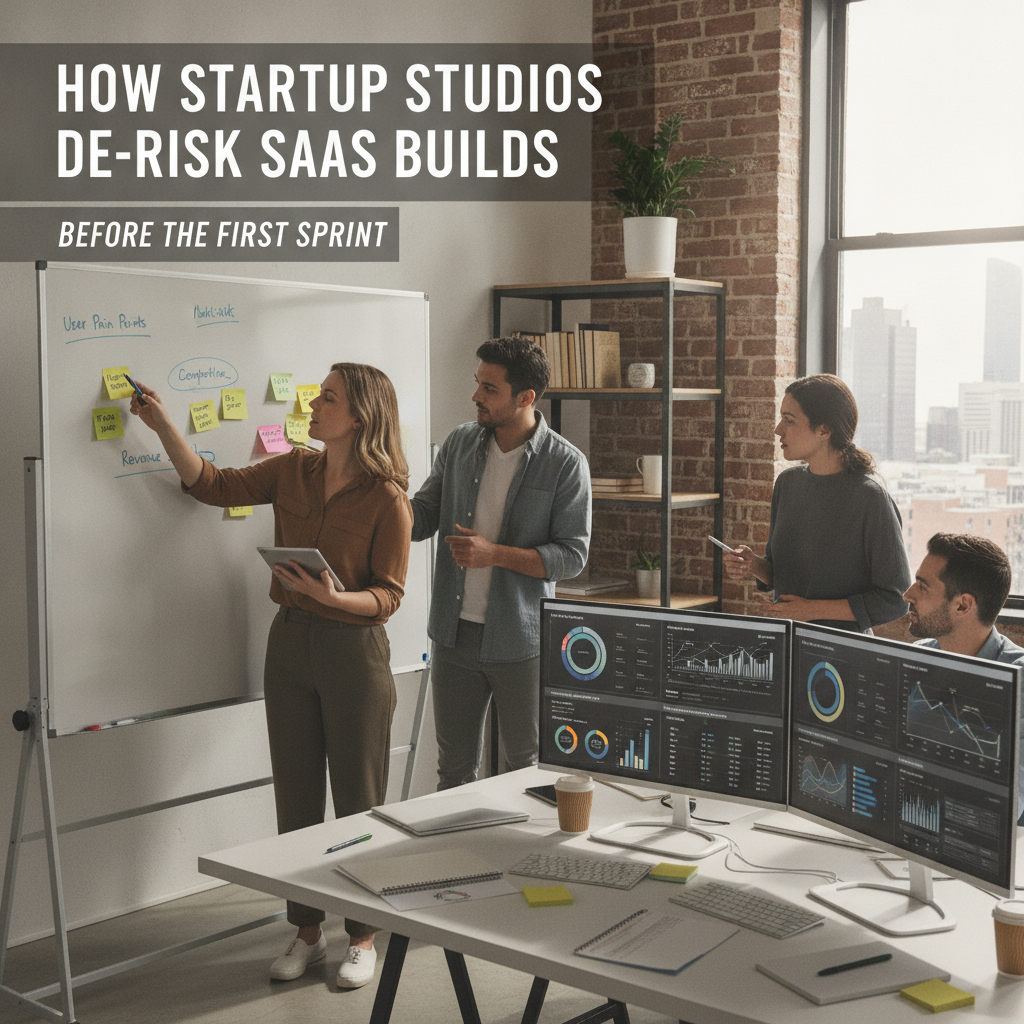Startup studio team analyzing customer evidence during a market risk validation sessionMarket validation investigates whether a business idea can survive contact with real customers. Studios refuse to build until they have hard proof of demand.
### The Why Now Framework
Studios investigate not just if a solution is needed, but why it is the right time to build it. This framework examines shifting market dynamics, regulatory changes, technology enablers, and broad behavioral shifts.
Example scenario: Remote work tools surged not just because video chat was new, but because a global event made remote work mandatory.
Key takeaway: A good solution deployed at the wrong time still fails.
### Problem Discovery
Studios rely on deep-dive interviews designed to observe actual user pain points. They avoid yes-or-no questions that lead respondents toward fake validation.
Common mistake: Asking customers if they think an idea is good. Instead, studios ask about recent experiences, daily frustrations, current workarounds, and exactly how much time or money the user spends on alternatives. They focus exclusively on the frequency and intensity of the pain. Sporadic annoyances do not build scalable businesses.
### Evidence-Based Success Metrics
Success is defined by tangible evidence rather than positive feedback. Following the principles outlined in Steve Blank's Customer Development methodology, studios demand concrete action from potential buyers.
Key signals studios look for:
- Willingness to pay (pre-orders, letters of intent, pilot commitments)
- Time investment (waiting list sign-ups, extensive beta participation)
- Current workaround costs (money spent patching together existing tools)
"I love this idea" is not validation. "I will pay $50 a month when you launch" is validation.
## How do startup studios conduct technical due diligence?
Technical due diligence is the silent killer of early-stage software. It answers one core question: Can this product be built within our defined time, budget, and capability constraints?
### What technical due diligence actually evaluates
Before approving a build, technical leaders assess several high-risk areas. They look at architecture feasibility to see if the system can handle expected loads. They map out integration complexity, searching for third-party APIs or legacy systems that might cause bottlenecks. They also evaluate the proposed data model to ensure it actively supports the future business model, projecting hosting and infrastructure costs at scale.
### Catching the silent killers early
When to use this: Always conduct architecture reviews before signing off on the product roadmap.
Studios identify whether the architecture can properly isolate customer data. According to the AWS Well-Architected SaaS Lens best practices, multi-tenancy security flaws are a massive liability. If customer data bleeds across accounts, the resulting re-platforming effort can bankrupt the company.
Studios also catch database design mistakes early. Discovering six months into a build that your chosen database cannot handle the query patterns needed for a core feature requires a complete migration.
### Choosing boring tech
Studios prioritize stability over novelty. They actively choose boring, proven tech stacks over hyped frameworks.
Benefits of boring tech:
- Deep community support and extensive documentation
- An abundant hiring pool for future team expansion
- Predictable behavior under heavy server load
- A much lower risk of sudden abandonment or breaking changes
Bleeding-edge frameworks often lack production-ready tooling. They introduce hidden complexity costs and require expensive, highly specialized talent. Use proven technology unless a new innovation provides a massive, measurable competitive advantage.
### Compliance by design
Regulated industries like healthcare, finance, and European markets require compliance from day one. Studios conduct strict pre-build compliance audits to address data residency, access logging, and encryption requirements. Adding GDPR, SOC 2, or HIPAA compliance post-launch requires architectural rewrites that cost three to ten times more than building it in upfront.
## What is the double-filter approach to idea validation?
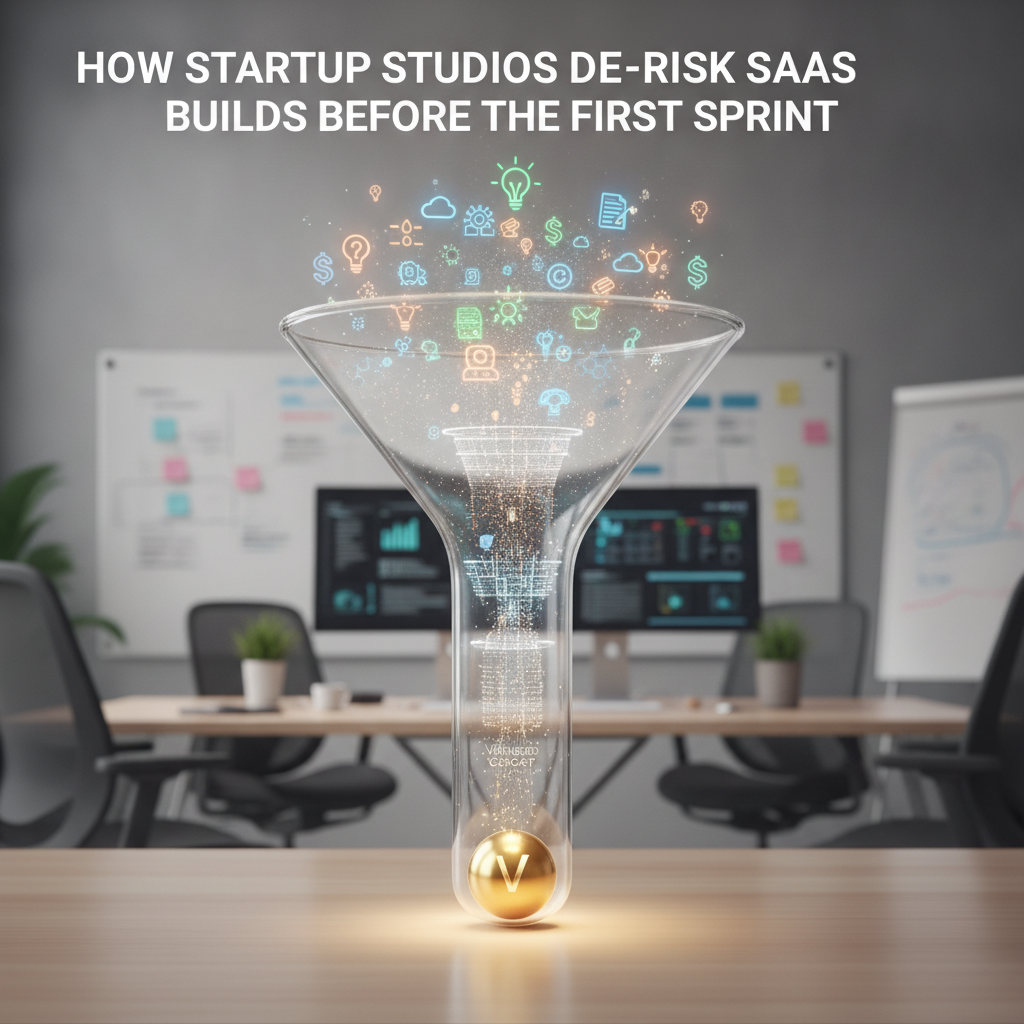The double-filter approach used by startup studios to eliminate weak ideas before developmentStartup studios function as an assembly line for software businesses. They generate multiple concepts but immediately toss the majority into the bin before development begins.
Step 1: The first filter tests market viability. Does evidence support strong demand, a willingness to pay, and defensible market positioning?
Step 2: The second filter tests technical feasibility. Can the engineering team build this with acceptable risk, on a realistic timeline, and within the allocated budget?
By filtering ruthlessly, studios concentrate their capital and talent only on the highest-probability opportunities. Independent builders often commit to a single idea emotionally. They push forward despite glaring red flags because they have no backup plan.
Think of this model like a venture capital deal flow. Studios might review dozens of internal ideas, but they only fund one or two per quarter. This discipline directly drives their higher Series A success rates because only fully validated concepts ever reach the production environment.
## How do studios avoid over-engineering the MVP?
Feature creep extends timelines and burns through capital rapidly. Studios keep development budgets under strict control by applying extreme Minimum Viable Product discipline.
### Trackable milestones and budget gates
Studios break development into weekly or bi-weekly milestones. Each milestone has strictly defined deliverables and budget caps. This allows project managers to detect scope creep or technical blockers early, well before they consume the startup's entire runway.
### MVP discipline
Studios maintain ruthless focus on the core value proposition. They know exactly what to cut and why.
Common early cuts:
- Advanced analytics (studios use off-the-shelf tools initially)
- Custom integrations (teams start with simple webhooks)
- Extensive white-labeling (standardize the interface first)
- Native mobile apps (a mobile-responsive web app is often sufficient for early validation)
For every proposed feature, studios ask: "Does removing this prevent us from testing our core hypothesis?" If the answer is no, the feature gets cut.
### Avoiding the feature trap
Founders often feel the product needs just one more feature to be ready. Studios demand hard evidence for new additions. Any new feature requires customer validation through interviews or survey data before entering the roadmap. Teams ship the product the moment they can test the core value proposition, not when the software feels completely finished.
## What shared expertise do studios provide from day zero?
Solo founders face massive team-building challenges. They must handle recruiting, equity negotiations, role definitions, and culture fit all at once. Studios bypass this by providing experienced, pre-assembled teams immediately.
### The instant team problem
A studio venture starts day one with a fractional CTO to guide architecture decisions and technology selection. It gets product design experts who understand user research methodology. It also receives operations and finance support to handle cap table management, fundraising preparation, and legal structures.
### Domain knowledge transfer
Studios accumulate valuable cross-project learnings. If a studio is building its fourth healthcare SaaS product, the team already brings deep regulatory knowledge, established architecture patterns, and vendor relationships to the table. Solo founders have to rediscover all these lessons the hard way.
### De-risking team dynamics
Early-stage team conflicts frequently kill startups. Studios provide proven working relationships and extremely clear role definitions. Standardized daily rituals like standups, sprint planning, and retrospectives prevent coordination failures. Joining a studio is like joining an established recording band with seasoned session musicians, rather than assembling players at your very first rehearsal.
## How much faster do studio-backed SaaS products reach market?
Time to market dictates startup survival. Faster launches mean lower burn rates and more runway for post-launch iteration.
Studios deploy standardized infrastructure right out of the gate. They utilize pre-built CI/CD pipelines, monitoring alerts, and authentication systems that solo founders usually build from scratch. Experienced studio teams also run market validation, technical architecture, and UI design simultaneously rather than sequentially.
Established frameworks eliminate weeks of research and debate over technology choices. Because of this parallel processing, studio-backed products routinely hit the market in four to eight months. Independent founders often take nine to eighteen months to reach the same MVP launch stage.
Crucially, the studio timeline includes rigorous pre-sprint validation. The launched product reaches the market faster, and it carries a significantly higher probability of achieving product-market fit.
## Does pre-sprint rigor really reduce technical debt?
Technical debt refers to coding shortcuts or poor design decisions that require expensive, time-consuming fixes later.
### What technical debt actually costs
Common sources of crippling technical debt include inadequate database designs that cannot support new features. Missing security layers often require massive architectural rewrites to achieve compliance. Monolithic architectures prevent teams from scaling components independently, and hard-coded business logic makes future customization incredibly expensive.
### How studios prevent accumulation
Studios use continuous architectural reviews during the build. Weekly or bi-weekly assessments ensure developers stick to the plan. Automated testing, security scans, and peer code reviews act as strict quality gates to prevent shortcuts from merging into the main codebase. Teams also maintain proper system documentation, enabling future developers to understand early design decisions.
### The re-platforming cost
Imagine a SaaS product hits 1,000 customers but discovers its architecture cannot handle 10,000. That startup now faces a complete rebuild. A typical re-platforming effort costs six to twelve months of development time, introduces massive customer migration risks, and forces a total feature freeze. Proper initial architecture scales from ten to 10,000 customers smoothly, proving that pre-sprint rigor pays massive dividends.
## FAQ
### How long should the pre-sprint discovery phase last for a SaaS product?
Most startup studios allocate four to eight weeks for comprehensive discovery. This includes market validation (two to three weeks), technical due diligence (one to two weeks), and compliance or architecture planning (one to two weeks). Studios with specific domain expertise can often compress this to three to four weeks by reusing existing knowledge. Solo founders should expect to spend six to twelve weeks if they are conducting rigorous discovery for the first time.
### What is the biggest mistake founders make before starting SaaS development?
Confusing positive feedback with actual purchase intent is the most common error. Founders often interpret "I love this idea" as validation, when it is usually just politeness. The critical mistake is skipping evidence-based validation. Studios require tangible proof, such as pilot agreements, pre-orders, or letters of intent that demonstrate a real willingness to pay before they authorize any development.
### Can non-technical founders use the startup studio methodology?
Yes. Non-technical founders can replicate the market validation side completely on their own. For the technical due diligence aspect, non-technical founders should hire a fractional CTO or engage a specialized technical consultancy for a few weeks before hiring a full development team.
### Does over-planning in the pre-sprint phase kill startup momentum?
No. Treating the pre-sprint phase as a strategic gate actually creates momentum. By eliminating technical unknowns and confirming exactly what the customer wants, the engineering team can build continuously without stopping to debate missing features or pivot the database structure mid-sprint.
---
**How this post looks on the live site:** Rendered in a windowed news reader inside the AWcode OS desktop, alongside other posts.
---
**Canonical HTML version:** https://awcode.com/news/how-startup-studios-de-risk-saas-builds-before-the-first-sprint
**About this document:** This is a plain-Markdown mirror of an AWcode.com page, served so that LLMs and agents can read the content without executing the site's retro-OS JavaScript UI. The HTML page at the canonical URL above carries the same content and is also fully indexable.
## Machine-readable
Resources for AI agents, LLMs and integrations:
- [https://awcode.com/llms.txt](https://awcode.com/llms.txt) — index of markdown mirrors
- [https://awcode.com/llms-full.txt](https://awcode.com/llms-full.txt) — every page + post concatenated
- [https://awcode.com/sitemap.xml](https://awcode.com/sitemap.xml) — full sitemap
- [https://awcode.com/robots.txt](https://awcode.com/robots.txt) — crawl + Content-Signal policy
- [https://awcode.com/ai.txt](https://awcode.com/ai.txt) — AI access policy
- [https://awcode.com/openapi.json](https://awcode.com/openapi.json) — OpenAPI 3.1 spec
- [https://awcode.com/.well-known/api-catalog](https://awcode.com/.well-known/api-catalog) — RFC 9264 / 9727 link set
- [https://awcode.com/.well-known/mcp.json](https://awcode.com/.well-known/mcp.json) — MCP discovery
- [https://awcode.com/mcp](https://awcode.com/mcp) — MCP server endpoint (POST JSON-RPC 2.0)
- [https://awcode.com/.well-known/agent-skills/index.json](https://awcode.com/.well-known/agent-skills/index.json) — Agent Skills index
### Public API — concrete examples
- [GET https://awcode.com/api/posts](https://awcode.com/api/posts) — list recent published posts
- [GET https://awcode.com/api/posts/how-startup-studios-de-risk-saas-builds-before-the-first-sprint](https://awcode.com/api/posts/how-startup-studios-de-risk-saas-builds-before-the-first-sprint) — fetch one post
- [GET https://awcode.com/api/pages/about](https://awcode.com/api/pages/about) — fetch the about page
### Markdown mirrors — concrete examples
- [https://awcode.com/index.md](https://awcode.com/index.md) — homepage
- [https://awcode.com/about.md](https://awcode.com/about.md) — about page
- [https://awcode.com/news/how-startup-studios-de-risk-saas-builds-before-the-first-sprint.md](https://awcode.com/news/how-startup-studios-de-risk-saas-builds-before-the-first-sprint.md) — one news post