Can One Codebase Power Both Your MVP and SaaS Growth?
2026-09-21
One Codebase for MVP and SaaS Growth: The Strategic Framework for 2026
Building one codebase that serves both your MVP and long-term SaaS growth is entirely possible when you choose mature, proven technology. The key is selecting a framework with enterprise features built in from day one, avoiding the trap of experimental tools that force expensive rewrites later. Laravel offers authentication, billing integrations, background queues, and API architecture right out of the box. Your initial code becomes a durable growth engine instead of technical debt.
Key Takeaways
- Startups using Laravel's cohesive ecosystem ship MVPs significantly faster than teams piecing together disparate packages
- Single codebases succeed when built on technology that includes scalability features from the start
- API-first design and simple tenant isolation provide the most efficient path to early-stage scale
- Modern deployment platforms like Laravel Forge and Vapor eliminate the need for dedicated early-stage DevOps engineers
- Stack selection is a business decision that buys insurance against costly future rewrites
The Rewrite Decision That Costs Startups
Founders often face a stressful dilemma after their initial launch. You hit 5,000 users. The application buckles under pressure. Your engineering team delivers bad news: they need to rebuild everything from scratch.
This tension between speed and scalability destroys momentum. Teams rush an MVP out the door using whatever tools are trending. They ignore structural integrity. The result is brittle code that cannot sustain user growth.
Creating a single codebase that serves early prototyping and long-term expansion is highly achievable with the right architectural choices upfront. The AWcode philosophy centers on using "boring technology" for these critical builds. You want tools that are predictable, documented, and thoroughly tested by millions of users.
By starting with a solid foundation, you save significant time and money. Your MVP code should evolve naturally into your enterprise product.
What Is the Scalability Trap and Why Do So Many Startups Fall Into It?

The scalability trap occurs when founders prioritize immediate speed so heavily that they accumulate fatal technical debt. They push a quick prototype to market. They gain unexpected user growth. They immediately run into severe performance issues. This inevitably leads to agonizing rewrite discussions.
Common causes include choosing highly experimental software stacks, skipping basic architecture planning, and adopting a reckless "we'll fix it later" mindset. Startups falsely believe they must choose between a fast release or a scalable architecture.
This trap carries massive financial consequences. A typical rebuild takes three to six months and costs between $150,000 and $300,000 in engineering salaries alone.
The opportunity cost during a rebuild is often worse than the direct financial expense. While your team rewrites old features just to keep the servers online, your competitors ship new features and capture your market share.
Why Does Your Technical Stack Choice Matter for Long-Term Growth?
Technical stack selection is a strategic business decision. It dictates your time-to-market, your ability to hire talent, and your total cost of ownership.
Founders frequently debate between "batteries-included" frameworks and "assemble yourself" approaches. A cohesive framework provides everything you need out of the box. The alternative requires you to stitch together dozens of tiny, independent packages just to get a working application.
The hidden costs of novelty are steep. Experimental frameworks often lack mature tooling, comprehensive documentation, and a reliable talent pool. When something breaks, your developers must read through source code instead of simply checking a manual.
> "The startups that win aren't using the newest technology. They are using proven tools that let them focus on their unique value proposition rather than reinventing authentication for the tenth time." (Sarah Chen, CTO at Laravel Consulting Group, Laravel News 2026)
Consistency is a massive advantage. Cohesive frameworks drastically reduce the surprise refactors that consume startup runway. They allow non-technical founders to accurately forecast feature delivery timelines.
Why Is Laravel the Strategic Choice for MVP and SaaS Growth?
Laravel holds a dominant market position in 2026. It is highly mature, actively maintained, and supported by a massive ecosystem. This environment makes it the ideal candidate for building one codebase for MVP and SaaS growth.
According to BuiltWith technology tracking data in 2026, Laravel powers over 1.8 million active websites, including SaaS platforms processing billions in annual transactions.
The primary advantage is accelerated velocity. Packages like Laravel Cashier handle complex Stripe billing logic instantly. Sanctum and Passport manage API authentication effortlessly. Filament provides instant, highly customizable administration panels.
The second major advantage involves built-in scalability features. Laravel includes standardized background queues, caching mechanisms, database migrations, and Horizon for queue monitoring. You don't have to architect these systems yourself.
Hiring friction is substantially lower compared to niche frameworks. The PHP and Laravel talent pool is massive, allowing you to scale your engineering team quickly and affordably.
Modern deployment tools like Laravel Forge and Vapor completely change early-stage operations. These platforms manage server provisioning and infrastructure automatically. Startups can deploy professional environments without paying for dedicated DevOps engineers during the MVP phase.
How Do You Design an MVP That Won't Need a Complete Rewrite?

The goal of any MVP is to validate market fit while building a professional architecture. You can achieve this by following clear, disciplined boundaries during early development.
<b>Rule 1:</b> Write code that is easy to change rather than code that tries to do everything. Focus heavily on clear separation of concerns.
<b>Rule 2:</b> Invest in boring, reliable patterns over clever abstractions. Clever code is difficult to read and even harder to debug six months later. Standardized approaches ensure any new developer can understand the logic immediately.
<b>Rule 3:</b> Follow the 80/20 rule for application design. Roughly 80% of your application should use standard, unmodified framework patterns. Save your custom engineering effort for the 20% that represents your unique business logic. User authentication is boring and should use standard tools. Your proprietary real-time pricing algorithm is where custom engineering belongs.
What Are the Essential Architecture Patterns for SaaS Codebases?
Setting up a few structural rules early on prevents massive headaches down the road. These specific patterns allow a standard application to scale cleanly.
API-First Design
<b>When to use this:</b> Always, even for web-only MVPs.
Building an API-first backend means your controllers return JSON data instead of tightly coupled HTML views. You then add Blade templates or a frontend framework as a separate presentation layer. This enables you to launch mobile applications, webhooks, and third-party integrations later without rebuilding your core backend logic. Laravel API Resources and Sanctum make this process entirely frictionless.
Simple Multi-Tenancy Strategy
<b>Common mistake:</b> Over-engineering database isolation on day one.
Almost all early SaaS platforms don't need complex database-per-tenant architectures. A single database with a `tenant_id` column on all relevant tables is the most efficient starting point. You can enforce data isolation using Eloquent global scopes to ensure users only see their own records. You only graduate to strict schema isolation when enterprise compliance regulations force your hand.
Domain-Based Code Organization
<b>Key takeaway:</b> Structure folders by business concept, not by technical function.
Instead of dumping every model into an `app/Models` directory, organize your codebase into domain folders like `app/Domains/Billing` or `app/Domains/Users`. This dramatically reduces confusion as your team expands. Developers intuitively know where logic belongs, keeping the codebase navigable as feature counts explode.
Feature Flags and Configuration
<b>Best practice:</b> Never hardcode feature toggles.
Feature flags allow you to deploy code to production without exposing the feature to users. You can enable gradual rollouts and test in live environments safely. Using the Laravel Config system and packages like Laravel Pennant, you can toggle features using environment variables or database-driven settings.
How Does AI-Assisted Development Change the MVP-to-Scale Timeline in 2026?
Artificial intelligence coding agents like GitHub Copilot, Cursor, and Claude are now standard requirements for software teams. They fundamentally alter the speed at which a single codebase reaches maturity.
The primary benefit is the automation of boilerplate code, basic test generation, and documentation. Teams can stay highly focused on complex business logic instead of typing out standard CRUD controllers.
Laravel holds a unique advantage in this landscape. AI models are trained extensively on open-source code. Because Laravel has a massive, highly standardized corpus of public code, AI tools generate exceptionally accurate Laravel snippets.
According to the GitHub "2026 Developer Productivity Report", developers see a 42% time savings on boilerplate code with AI assistance.
AI outputs still require strict human review to ensure security and logical accuracy. However, by reducing repetitive work by nearly half, small startup teams can accomplish the output of much larger departments. This dynamic effectively extends startup runway.
When Should You Consider Multi-Codebase Architecture?
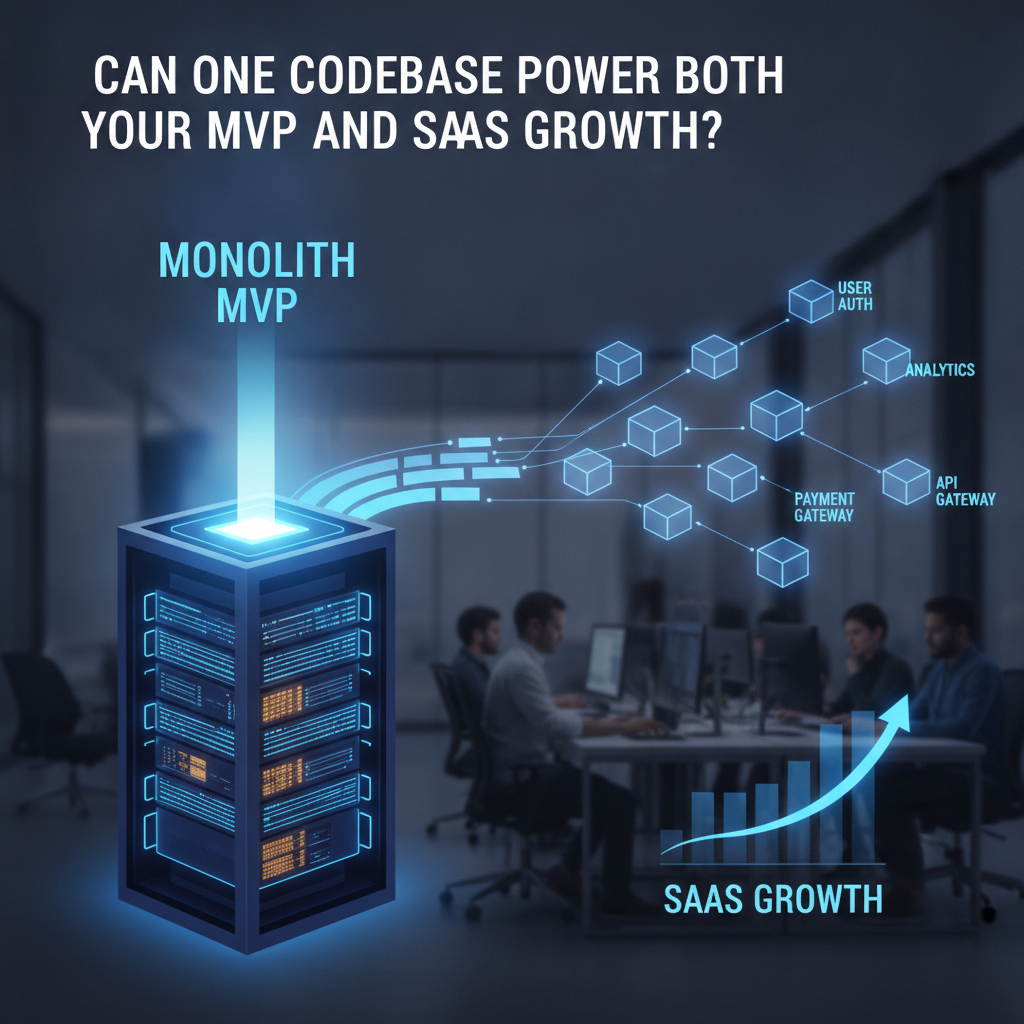
Most startups won't need a multi-codebase architecture until they reach Series B funding or later. Starting with microservices is a well-known anti-pattern for early companies.
Valid reasons to split your codebase eventually include having distinct products managed by entirely separate teams. You might also need extreme regulatory compliance isolation for a specific feature. Occasionally, a platform reaches a scale where the public API has completely different server requirements than the internal reporting dashboard.
Invalid reasons are far more common. Adopting microservices simply because it sounds like a best practice adds crippling operational complexity. Using different programming languages for different features usually introduces communication barriers without providing real benefits.
Use the monolith-first approach. Start with a single, well-structured Laravel codebase. You can build logical boundaries inside the monolith first. You only extract services into separate codebases when highly specific pain points emerge that cannot be solved by upgrading server hardware.
What Are the Warning Signs Your Codebase Won't Scale?
Catching structural problems early is entirely possible. If you spot these red flags, you can correct course without throwing the whole project away.
- <b>Red flag 1:</b> No separation between business logic and presentation. If your controllers contain hundreds of lines of complex math or API calls, the code is tightly coupled and difficult to test.
- <b>Red flag 2:</b> Direct database queries are scattered randomly throughout the codebase. Use the repository pattern or strict model methods to centralize database interactions.
- <b>Red flag 3:</b> Zero test coverage. If you don't have automated tests, you cannot refactor old code safely. Every update becomes a massive risk.
- <b>Red flag 4:</b> Synchronous operations are blocking user requests. Sending emails or processing heavy images while the user waits for a page load will crash your servers under heavy traffic. You must use background queues for these tasks.
- <b>Red flag 5:</b> Hard-coded configuration values. Passwords, API keys, and server URLs typed directly into files will cause deployment disasters. Use environment variables exclusively.
- <b>Red flag 6:</b> A complete lack of caching. Hitting the database for unchanging data on every page load will exhaust your connections rapidly.
The good news is that every single one of these issues is easily fixable in Laravel if caught during the MVP phase.
Real-World Examples of SaaS Companies That Scaled on Laravel
Many prominent software platforms evolved their original codebases to handle massive traffic without requiring a change in framework.
Invoice Ninja
Invoice Ninja serves hundreds of thousands of businesses globally. Their initial MVP launched quickly to handle basic invoicing. As they grew, they utilized Laravel's robust ecosystem to add complex recurring billing, client portals, and multi-tenancy features. They never had to abandon their PHP roots to achieve enterprise scale.
Monica CRM
Monica is an open-source personal CRM designed to handle highly relational data. Starting as a simple weekend project, the codebase expanded into a mature product handling millions of relationships. Their adherence to standard Laravel conventions allowed open-source contributors to help scale the platform efficiently without architectural chaos.
Laracasts
Often referred to as the Netflix for developers, Laracasts handles massive amounts of high-definition video streaming traffic and complex subscription states. The platform started as a basic membership site. By utilizing Laravel's caching, queues, and robust database optimization, Laracasts smoothly scaled to serve hundreds of thousands of paying subscribers.
Your SaaS Technology Checklist Before You Build
Review these specific questions with your engineering team before writing the first line of code.
Framework Questions
- Does the chosen tool have mature billing and subscription integrations ready to install?
- Does it handle secure authentication and authorization automatically?
- Does it support simple configuration for background jobs and message queues?
- Is there a large, accessible talent pool for hiring future developers?
Architecture Questions
- Are we building API-first to ensure future client flexibility?
- How will we handle data isolation between different customers?
- What is the automated deployment strategy for moving code to production?
- How will we manage environment-specific configurations safely?
Business Questions
- Can our team realistically ship a functional MVP in six to eight weeks using this stack?
- Can this specific codebase comfortably grow to 10,000 active users without a structural rewrite?
- What is our explicit strategy for managing and paying down technical debt?
FAQ
Is Laravel still relevant in 2026?
Yes. Laravel is highly relevant and continues to dominate the SaaS ecosystem. With modern capabilities in Laravel 11, serverless deployment via Vapor, and extreme performance gains through Laravel Octane, it competes directly with enterprise Java and Node stacks. The myth that PHP is dead is completely false. Major Fortune 500 companies and thousands of profitable startups rely heavily on the framework daily.
How much does it cost to build a SaaS MVP with Laravel?
Building a SaaS MVP with Laravel typically costs between $15,000 and $50,000 depending on the complexity of your business rules. This budget covers development hours, basic hosting, and essential third-party services. Because the framework provides free authentication, routing, and database management tools, you save tens of thousands of dollars compared to building a custom Node stack from scratch.
Can I migrate from Laravel to another framework later if needed?
You can migrate away from Laravel, but it's rarely necessary. If you followed an API-first architecture, your mobile apps and frontends are already decoupled. You could theoretically rewrite backend microservices in Go or Rust while keeping the core Laravel application running. However, historical data shows very few successful SaaS companies bother switching away from Laravel once they achieve scale.
What is the difference between Laravel and WordPress for SaaS?
WordPress is a Content Management System built primarily for publishing posts and pages. Laravel is an application framework designed to build custom software. While you can force WordPress to act like a SaaS using heavy plugins, it quickly becomes unmanageable. Laravel is the correct choice for custom business logic, secure APIs, and complex user workflows. WordPress remains best for marketing sites and heavy content publishing.
Do I need a DevOps engineer to deploy a Laravel application?
You don't need a dedicated DevOps engineer in 2026 for a standard MVP. Managed deployment platforms like Laravel Forge, Vapor, and Ploi handle server provisioning, SSL certificates, and load balancing automatically. You typically only need to hire dedicated DevOps staff when you reach Series A funding, cross 50,000 daily active users, or require complex custom container orchestration.
Strategic Takeaway: Your Codebase Is a Business Asset
Your codebase is not just a technical requirement. It is a fundamental business asset that functions as either a competitive advantage or a financial liability.
Choosing a robust ecosystem like Laravel acts as insurance against expensive future rewrites. The AWcode philosophy emphasizes that boring, proven technology results in highly predictable outcomes. Predictability creates capital efficiency.
Audit your proposed technology stack against the questions provided above. If you're starting fresh, default to established tools that let you focus entirely on your customers. Your technology should propel your business forward, not hold it back.